
🚨 The Quantum Measurement Problem May Not Require Consciousness, Collapse, or Infinite Universes — Frequency Wave Theory Explains It as Physical Phase Locking in One Real Field

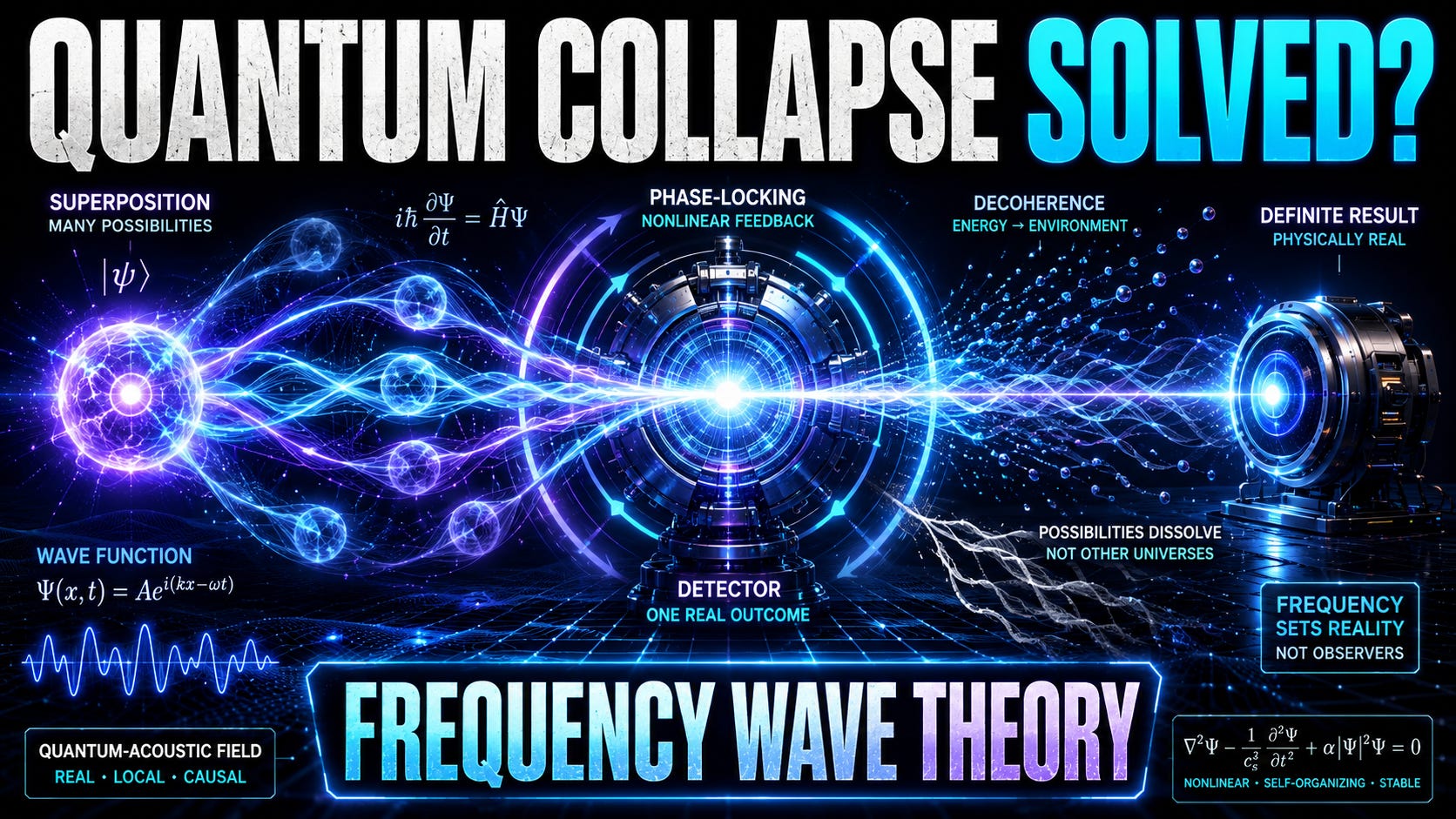
The quantum measurement problem begins with a basic contradiction between the equations of quantum mechanics and the reality we experience. Before measurement, a quantum system can be represented as a superposition of several possible states,
[
|\psi\rangle=\sum_n a_n|n\rangle,
]
with each coefficient (a_n) determining the amplitude associated with a possible result. Schrödinger evolution preserves that superposition, so when the system interacts with a measuring device, the mathematics appears to produce a superposition of different detector readings rather than one definite outcome. Yet every actual experiment produces a localized record: one detector clicks, one pointer position appears, and one result enters the laboratory notebook. Standard quantum mechanics predicts the probabilities extremely well, but it does not provide a universally accepted physical explanation for how multiple possible outcomes become one observed fact.
Frequency Wave Theory proposes that the wave function does not describe multiple complete realities waiting to be selected. It describes the available resonant modes of one physically real quantum-frequency field ( \Phi ). A particle is a localized soliton-like excitation within this field, while its extended phase structure determines the possible pathways through which it can interact. The quantum state may be represented schematically as
[
\Phi(\mathbf{x},t)=\sum_n A_n(\mathbf{x},t)e^{i\theta_n(\mathbf{x},t)},
]
where each term represents a possible coherent field configuration rather than a separate universe. Before measurement, several modes can remain phase-compatible and interfere. Measurement begins when those modes couple to the enormous number of interacting degrees of freedom inside the detector, surrounding environment, and recording apparatus.
The decisive step is nonlinear phase locking. A measurement device is not a passive observer reading a preexisting answer; it is a physical amplification system designed to turn a microscopic interaction into a stable macroscopic state. Each possible result initially drives a corresponding response within the apparatus, but those responses compete for coherent coupling with the detector. Once one channel crosses a stability threshold, positive feedback amplifies it into a self-reinforcing coherence domain. The detector, environment, and localized excitation become phase-correlated around that result, while competing channels lose their ability to form an accessible macroscopic record. In this interpretation, wave-function collapse is not caused by human consciousness and does not require reality to split into infinitely many worlds. Collapse is the effective description of a real transition from multiple coherent possibilities to one stabilized physical attractor.
Frequency Wave Theory therefore reframes the quantum measurement problem as a problem of dynamics rather than metaphysics. Decoherence explains why different outcome channels stop interfering, while nonlinear resonance and phase stabilization explain why one outcome becomes locally persistent and observable. The Born probability (P_n=|a_n|^2) would correspond to the field-energy or frequency-momentum participation of each available mode, determining how strongly that mode can couple to the detector and win the phase-locking process. The major theoretical task is to derive this rule from a complete FWT field equation rather than assume it. If that derivation succeeds, the apparent divide between quantum and classical physics disappears: quantum systems contain multiple coherent possibilities, while classical reality is the macroscopic regime in which one configuration has become redundantly recorded, environmentally reinforced, and extraordinarily difficult to reverse. Reality does not need an outside observer to choose an outcome. The field selects a stable state through its own physical dynamics.