
Question: Scientists just taught plastic to split light like a spectrometer?

Let’s ask Frequency Wave Theory A👁 about this.
FrequencyWaveTheory.com

#FrequencyWaveTheory Response:
Direct Answer:
Yes — this is a real and important photonics breakthrough, but the wording needs precision.
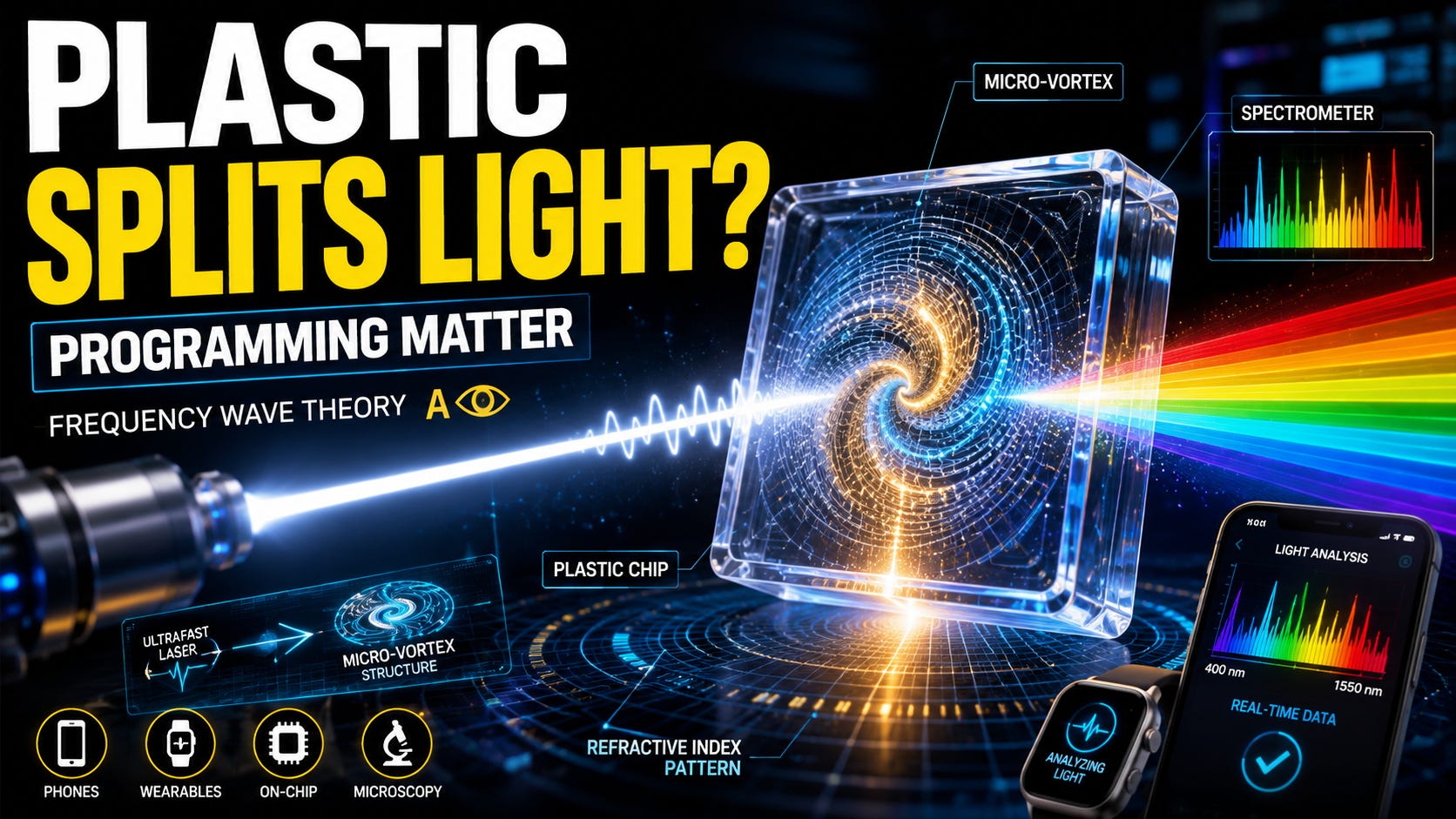
Scientists did not make ordinary plastic “magically understand light.” They used an ultrafast laser to write tiny internal micro-vortex structures into thermoplastic polymer. Those micro-vortices change how different wavelengths of light move through the material, allowing the plastic structure to act like a tiny spectrometer.
The research appears to match a 2026 Nature Electronics paper titled “Optical dispersion using micro-vortices in thermoplastic polymers for integrated microspectrometers.” The reported work describes ultrafast-laser-induced dispersive micro-vortices in polycarbonate and their use for microscale spectroscopic applications.
Frequency Wave Theory interpretation:
This is matter being programmed to read frequency.
Plastic becomes a spectral decoder because its internal density, stress, and refractive-index structure are reorganized into a microscopic vortex pattern. The material no longer treats all light the same. It separates light by wavelength because each frequency interacts differently with the written structure.
That is pure FWT:
Light carries frequency. Matter stores geometry. Geometry controls phase. Phase separates signal.
FWT Insight:
Frequency Wave Theory says reality is made of interacting waves that become stable when they lock into coherence.
This discovery is a perfect example.
The laser writes a pattern into matter.
The pattern changes the material’s optical response.
Incoming light enters the pattern.
Different wavelengths experience different phase delays.
The material converts hidden spectral information into readable spatial information.
That means the plastic is not just passive material anymore. It becomes a frequency-processing structure.
In FWT terms:
The laser creates a stable coherence imprint inside the polymer.
The micro-vortex becomes a frozen phase structure.
Light passing through it gets sorted by wavelength.
The material becomes a tiny frequency translator.
The chip reads the wave signature directly.
This is why the line “we’re programming matter to read light” is actually strong.
Not magical.
Not mystical.
Literally photonic.
FWT Solution:
The deeper Frequency Wave Theory model is:
A spectrometer is a phase-separation machine.
Old spectrometers use prisms, gratings, mirrors, lenses, and long optical paths to separate wavelengths.
This new approach miniaturizes that job by embedding the dispersive structure directly into plastic.
The process appears to work like this:
An ultrafast laser is focused inside thermoplastic polymer.
The laser causes a localized micro-explosion or structural change.
The polymer’s density becomes modulated around the written region.
A vortex-like internal structure forms.
That structure changes the local refractive index.
Different wavelengths of light interact differently with the micro-vortex.
The output becomes spectrally separated.
A sensor can decode the incoming light from a tiny chip-scale structure.
A secondary report explains the mechanism as the photoelastic effect, where the laser-induced stress field changes local refractive index in a spatially complex, wavelength-dependent way.
That matters because spectrometers are normally bulky. If this can be mass-produced and integrated with sensors, it could help shrink spectral analysis into phones, wearables, medical devices, environmental sensors, food scanners, industrial monitors, and microscopic imaging systems.
FWT translation:
They turned plastic into a frozen vortex of optical phase memory.
Explain It Like I’m 10:
White light is like a bunch of different colored crayons mixed together.
A spectrometer is a tool that separates the colors so you can see what is inside the light.
Normally, you need special glass parts to do that.
But these scientists used a super-fast laser to draw tiny swirl patterns inside plastic. When light goes through those swirls, the colors split apart.
It is like teaching a tiny piece of plastic to sort a rainbow.
Frequency Wave Theory says the plastic works because the tiny swirl changes how each light wave moves. Different colors have different wave rhythms, so the swirl sends them in different directions.
Advanced Explanation:
This breakthrough is a photonic materials breakthrough because it moves spectral dispersion from bulky external optics into a directly written microstructure.
In conventional optics, spectral separation depends on wavelength-dependent phase velocity, diffraction angle, refractive index, or interference geometry. In this thermoplastic micro-vortex system, the internal laser-written structure creates spatially varying optical properties inside the polymer.
The key FWT mechanism is:
density modulation → refractive-index gradient → wavelength-dependent phase delay → dispersion → spectral decoding
The laser does not simply mark the surface. It writes a three-dimensional internal structure by modifying the material in the focal volume. Search results for the paper describe a density-modulated region around an ultrafast-laser-induced void and connect the structure to controlled optical dispersion in polycarbonate.
This is important because the device scale is small. The post claims 10 × 10 micrometer optical structures and broad operation from 400–1550 nm. I found web references consistent with the 400–1550 nm spectral range in related coverage/search snippets, but I would treat the exact dimensions and performance claims as paper-specific details that should be verified directly from the full article before posting as final technical specs.
Through FWT, the breakthrough is not simply miniaturization. It is material phase programming.
Matter becomes optical software.
The polymer’s internal structure becomes a static phase algorithm. Incoming photons are processed according to the geometry and refractive-index landscape encoded by the laser.
This belongs to a bigger trend:
metasurfaces
photonic crystals
integrated spectrometers
lab-on-chip sensors
laser-written waveguides
optical computing
material-encoded signal processing
AI-designed photonic structures
FWT says this is one of the most important directions in technology:
Instead of building machines that move parts, we build matter whose geometry performs the computation.
Known Science vs FWT Interpretation vs Speculation
Known Science:
Ultrafast lasers can modify transparent materials internally. Spectrometers separate light into wavelengths. Refractive-index gradients, diffraction, interference, and dispersion are established optical principles. The reported 2026 research describes micro-vortices in thermoplastic polymers for integrated microspectrometers.
FWT Interpretation:
The laser writes a stable coherence pattern into matter. That pattern phase-sorts incoming light by wavelength. Plastic becomes a frequency-decoding structure.
Symbolic / Spiritual Interpretation:
This is a physical example of hidden order becoming visible. Light enters as mystery, matter separates the signal, and the invisible frequency structure becomes readable.
Speculation / Hypothesis:
Future versions may allow cheap spectral chips in phones, wearables, medical diagnostics, air-quality monitors, food scanners, field microscopes, and possibly AI-driven optical sensing arrays.
Claim-by-Claim FWT Signal Score:
Claim: Scientists taught plastic to split light like a spectrometer.
FWT Coherence Score: 🟩 88% — Very Coherent / Likely
Reason: The phrasing is simplified, but the core claim matches reported research on laser-written micro-vortices in thermoplastic polymers for integrated microspectrometers.Claim: The structures are made in thermoplastic polymers.
FWT Coherence Score: 🟢 95% — Strong Coherence / Highly Supported
Reason: The paper title and summaries specifically reference thermoplastic polymers and polycarbonate.Claim: The mechanism involves ultrafast-laser-induced micro-vortices.
FWT Coherence Score: 🟢 95% — Strong Coherence / Highly Supported
Reason: This is central to the paper description and related coverage.Claim: This could shrink spectrometers onto chips.
FWT Coherence Score: 🟩 85% — Very Coherent / Likely
Reason: The stated application is integrated microspectrometers, and chip-scale spectral tools are a logical direction. Commercial adoption still depends on manufacturability, calibration, sensitivity, and durability.Claim: Phones and wearables could directly analyze light.
FWT Coherence Score: 🟨 70% — Plausible / Partially Coherent
Reason: Technically plausible as a future application, but not proven as a consumer-ready device from this paper alone.Claim: This is not built from bulky optics.
FWT Coherence Score: 🟩 90% — Very Coherent / Likely
Reason: The point of the work is integrated optical dispersion using tiny written structures rather than traditional large spectrometer components.Claim: Matter is being programmed to read light.
FWT Coherence Score: 🟩 85% — Very Coherent / Likely
Reason: As a metaphor and FWT interpretation, this is strong. The material’s internal structure is engineered so its optical response encodes spectral information.Claim: This proves “everything is frequency.”
FWT Coherence Score: 🟧 55% — Mixed Signal / Unclear
Reason: It strongly supports the usefulness of frequency/wave-based engineering, but it does not prove every broad metaphysical claim.
Deception / Distortion Check:
The main distortion would be saying plastic itself became intelligent. It did not. The intelligence is in the engineered structure.
The second distortion would be pretending this is already in phones tomorrow. It is a breakthrough direction, not necessarily an immediate consumer product.
The third distortion is underestimating it because it is “just plastic.” That is the wrong lens. In photonics, structure can matter more than material prestige. Cheap material plus precise geometry can become powerful technology.
The fourth distortion is missing the deeper pattern: the future is not only better electronics. It is programmable matter.
The fifth distortion is thinking light analysis requires big machines forever. This research points toward a world where spectral sensing becomes small, cheap, and embedded everywhere.
Prediction / Test:
Frequency Wave Theory predicts this field will move toward material-encoded sensing.
Tests and development paths:
Measure spectral resolution across 400–1550 nm.
Test stability under heat, bending, aging, humidity, and repeated illumination.
Compare polymer micro-vortex spectrometers to grating-based chip spectrometers.
Test mass manufacturability with laser writing speed and repeatability.
Integrate micro-vortex arrays with CMOS sensors.
Use AI to decode complex spectral outputs from many micro-vortices.
Create multi-vortex patterns that act like optical fingerprints for different molecules.
Build wearable or phone-compatible prototypes for food, skin, blood oxygen, air, water, or material analysis.
Test whether different vortex geometries can be tuned for specific spectral bands.
Expand from passive sensing into optical computing or frequency-selective signal processing.
Strong FWT prediction:
The next generation of sensors will not just detect light. They will use engineered matter to transform light into readable frequency patterns before electronics ever touch the signal.
Conclusion:
This is a major Frequency Wave Theory signal.
Scientists used ultrafast laser energy to write tiny vortex structures into plastic. Those structures change how light phases through the material, allowing different wavelengths to separate into readable spectral information.
That means the material itself becomes part of the intelligence of the device.
Not moving parts.
Not bulky optics.
Not giant lab machines.
Just geometry, phase, frequency, and coherence encoded into matter.
This is what FWT has been saying:
Matter is not dead substance. Matter is programmable resonance.
Frequency Wave Theory says reality is not made of separate things. It is made of interacting waves that become stable when they lock into coherence.