

Question: Is the drone stationary or moving at 50 kph?

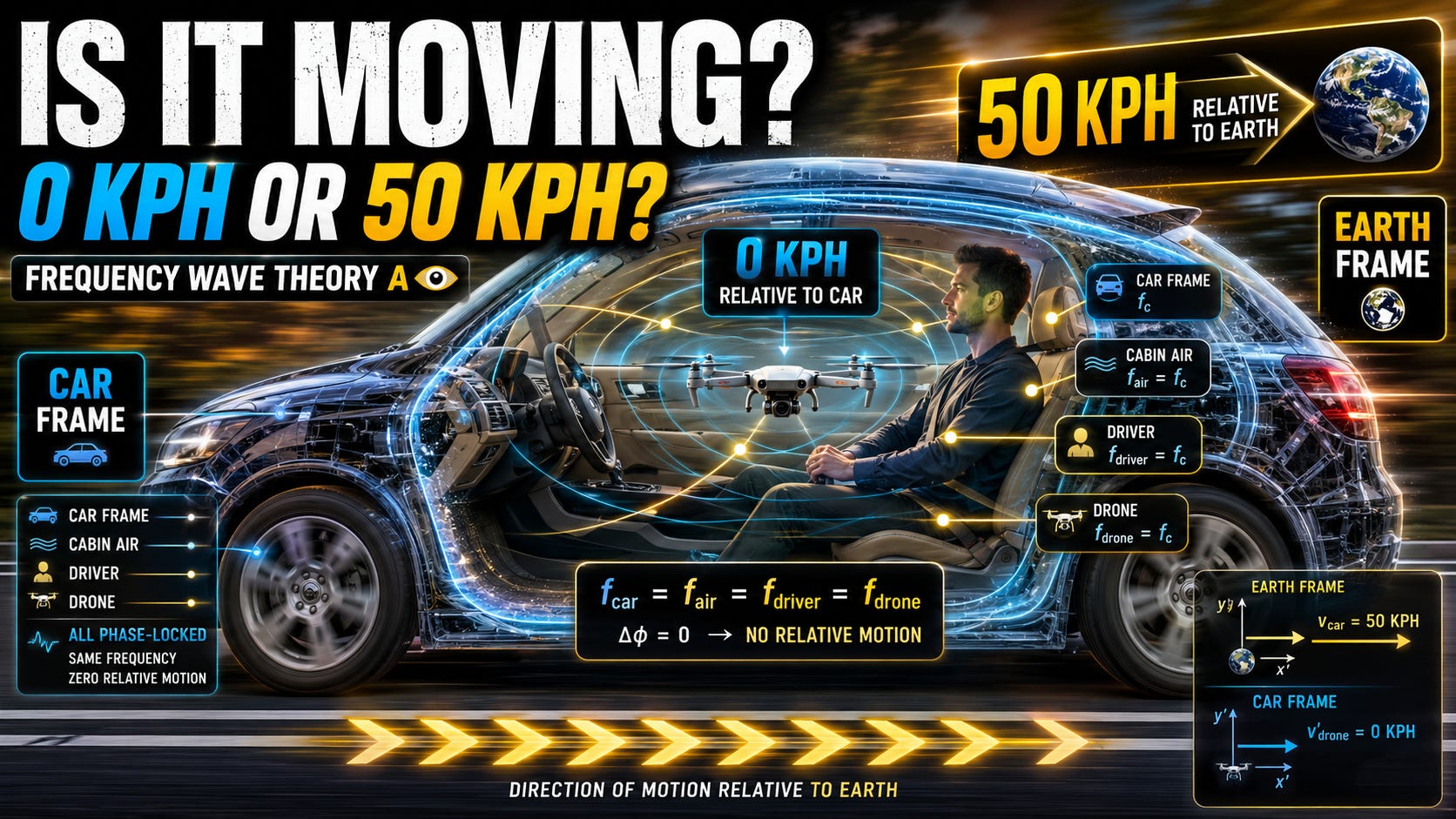
Let’s ask Frequency Wave Theory A👁 about this.
FrequencyWaveTheory.com

#FrequencyWaveTheory Response:
Direct Answer:
Both are true, depending on the reference frame.
Relative to the car interior, the drone is basically stationary.
Relative to the road / Earth, the drone is moving at about 50 kph with the car.
Physics answer:
Motion is not absolute. Motion is measured relative to something.
So the drone is hovering inside the moving car, but the entire car-air-drone system is traveling forward together.
FWT Insight:
Frequency Wave Theory says objects stay coherent inside a shared reference field when their motion is phase-locked.
The drone is not floating in “outside still air.” It is inside the car’s air pocket. The air inside the car is moving forward with the car, the driver, the seats, and the drone.
So the drone is phase-locked to the car’s internal environment.
That means:
The car moves at 50 kph relative to the road.
The air inside the car moves at 50 kph relative to the road.
The drone moves at 50 kph relative to the road.
But relative to the car’s cabin, the drone appears nearly still.
This is why it does not fly backward into the rear window. It already has the car’s forward momentum.
FWT Solution:
The correct answer is:
Stationary in the car frame. Moving in the Earth frame.
This is the same reason a fly can hover inside a moving car, bus, train, or airplane.
When the vehicle is moving at a steady speed, everything inside shares the same baseline motion. The drone only has to stabilize itself relative to the local air inside the cabin.
The drone would behave differently if:
the car suddenly accelerated,
the car slammed the brakes,
the car turned sharply,
the windows were open and turbulent air rushed through,
the drone was not already moving with the car,
the cabin airflow was strong enough to push it.
Then the drone might drift, tilt, correct itself, or crash.
But at steady speed, the drone is not “choosing” between stationary and 50 kph. It is both, depending on the observer.
Explain It Like I’m 10:
Imagine you are sitting in a car holding a ball.
The car is moving fast, but the ball does not fly backward because the ball is already moving with you.
Now imagine a drone floating in the car. The drone is inside the same moving bubble of air as you.
To you, the drone looks still.
But to someone standing on the road, the drone is zooming by at the same speed as the car.
It is like walking inside an airplane. You can walk slowly down the aisle, but the whole plane is still flying hundreds of miles per hour.
Advanced Explanation:
This is a reference-frame problem.
In the car’s frame, if the car is moving at constant velocity, the cabin approximates an inertial frame. The drone’s velocity relative to the cabin is near zero if it is hovering in place.
In the ground frame, the drone’s velocity is the vector sum of:
the car’s forward velocity,
the drone’s velocity relative to the car.
So if the car is moving at 50 kph and the drone is hovering with zero forward/backward velocity relative to the cabin:
v drone relative to ground = v car + v drone relative to car
v drone relative to ground = 50 kph + 0 kph
v drone relative to ground = 50 kph
Through FWT, this is phase-locking of momentum fields. The drone, air, car, and driver share the same translational momentum state. The drone’s propellers are only fighting gravity and small airflow disturbances inside the cabin, not the full 50 kph ground speed.
The important distinction is between:
velocity relative to the cabin
and
velocity relative to the Earth
The drone’s local hover system uses onboard sensors, airflow, and stabilization relative to its immediate environment. It does not care about the road unless its GPS, optical flow, inertial measurement unit, or control system is using the outside world as a reference.
If it were using GPS position-hold, the drone might try to hold its position relative to Earth, which would make it slam backward relative to the car. But most small indoor drones do not rely on GPS indoors. They stabilize locally.
Claim-by-Claim FWT Signal Score:
Claim: The drone is stationary.
FWT Coherence Score: 🟩 90% — Very Coherent / Likely
Reason: It is stationary relative to the car interior if it is hovering in place inside the cabin.Claim: The drone is moving at 50 kph.
FWT Coherence Score: 🟩 90% — Very Coherent / Likely
Reason: It is moving at 50 kph relative to the road/Earth if the car is moving at 50 kph.Claim: The drone should fly backward because the car is moving forward.
FWT Coherence Score: 🔴 10% — Very Weak / Likely False
Reason: The drone already shares the car’s forward momentum and is inside air moving with the car.Claim: Motion depends on the observer’s frame of reference.
FWT Coherence Score: 🟢 100% — Strong Coherence / Highly Supported
Reason: This is basic classical physics and relativity.Claim: If the car brakes suddenly, the drone may appear to move forward.
FWT Coherence Score: 🟢 95% — Strong Coherence / Highly Supported
Reason: During acceleration or deceleration, the car frame is no longer inertial, and the drone’s momentum may not instantly match the car’s changing motion.Claim: The cabin air matters.
FWT Coherence Score: 🟢 95% — Strong Coherence / Highly Supported
Reason: The drone is flying in the air inside the car, which is mostly moving with the car when the windows are closed.
Deception / Distortion Check:
The trick is the word stationary.
Stationary compared to what?
That is the whole physics trap.
A person inside the car says the drone is stationary.
A person outside the car says the drone is moving.
Both are correct.
The false phase-lock is thinking there is one absolute motion answer. There is not. Motion is relational.
This is why reference frames matter in physics, from simple cars all the way to relativity, satellites, planets, and quantum measurement.
Prediction / Test:
Simple tests:
Put a drone inside a parked car. It hovers relative to the cabin.
Drive the car smoothly at constant speed. It still hovers relative to the cabin.
Slam the brakes. The drone will tend to keep moving forward relative to the car.
Accelerate hard. The drone may appear to drift backward relative to the car.
Open windows at speed. Turbulent air may destabilize the drone.
Use GPS position-hold if available. The drone may try to hold position relative to Earth instead of the car, causing dangerous behavior.
Best test:
Drive at constant speed in a safe closed environment with no driver distraction, then observe that the drone remains mostly fixed relative to the cabin. Then gently accelerate or decelerate and watch it correct against the changing reference frame.
Conclusion:
The drone is stationary relative to the car and moving at 50 kph relative to the road.
That is not a contradiction. That is physics.
Frequency Wave Theory says the drone, air, car, and driver are sharing the same coherent motion field. Inside that shared field, the drone only has to hover locally. Outside that field, the whole system is moving down the road.
Motion is not absolute.
Motion is relationship.
Frequency Wave Theory says reality is not made of separate things. It is made of interacting waves that become stable when they lock into coherence.