
Physicists Found a Universal Geometry Behind Wave Collapse

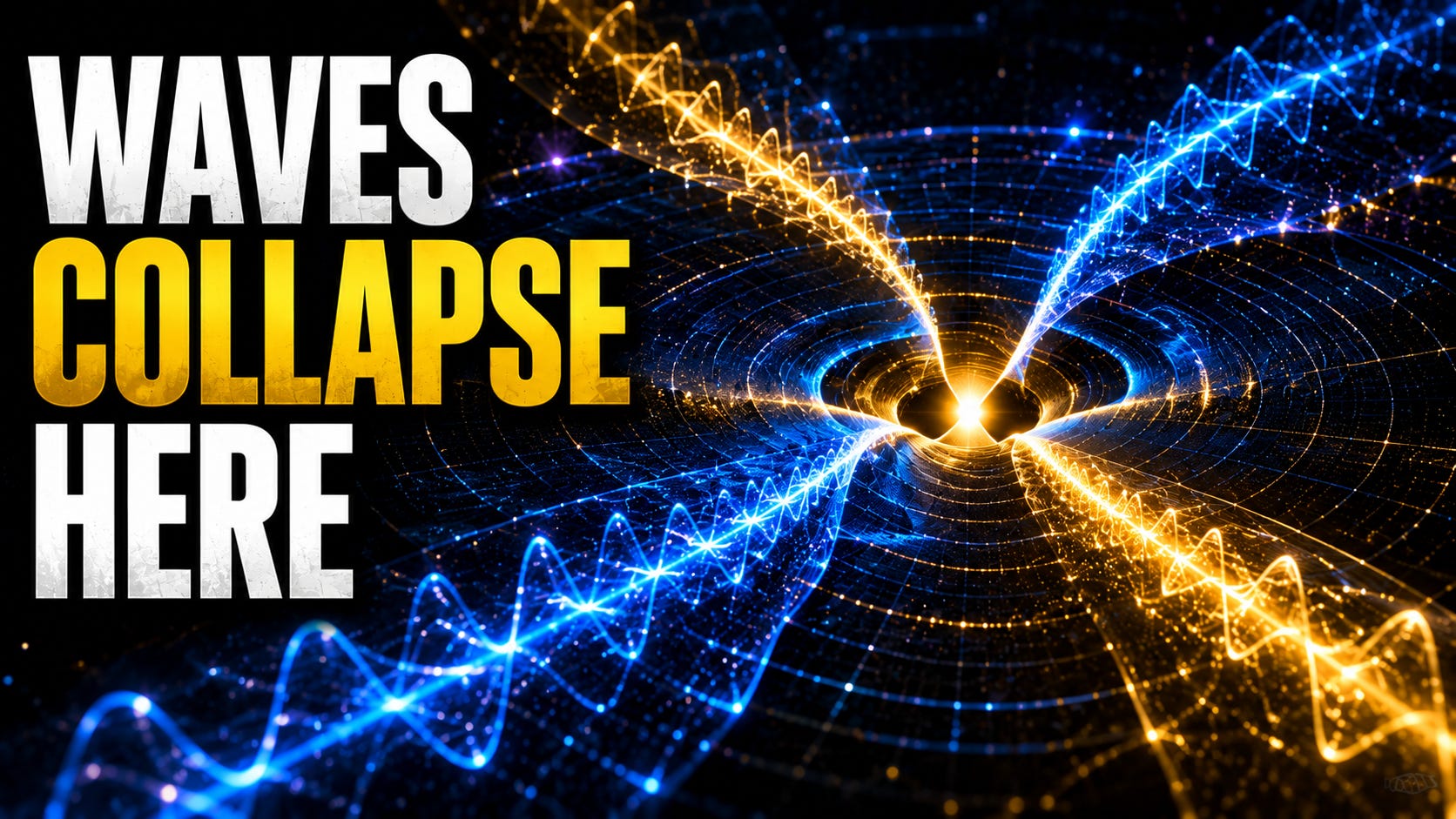
A new theoretical study has identified a common geometric structure behind exceptional points in a large class of nonlinear systems. Exceptional points occur in open or dissipative systems when modes and their eigenvalues merge. The researchers found that the surrounding nonlinear solution space follows an elliptic-umbilic topology, potentially giving scientists a general map for locating and classifying these critical transitions.
This is not a report of a newly built sensor or a direct laboratory measurement. It is a mathematical analysis of nonlinear non-Hermitian systems. The authors show that what appears as a second-order exceptional point in a linear description can correspond to four nonlinear eigenvectors coalescing. Their framework may help establish realistic limits on exceptional-point sensitivity enhancement.
I interpret that universal geometry through Frequency Wave Theory as a map of competing coherent wave organizations. FWT proposes that stable physical structures arise through standing waves, solitons and phase-locked states in an underlying field. An exceptional point may model the threshold where several allowed organizations become indistinguishable before the system abruptly selects a different phase or propagation mode.
To test that proposal, laboratories could implement mathematically equivalent exceptional-point loops in photonic resonators, coupled acoustic cavities and mechanical oscillators. They would measure phase winding, stored energy, transition delay and hysteresis while normalizing drive and loss. FWT predicts a common scaling based on FM=12ρωA2FM=\frac12\rho\omega A^2FM=21ρωA2, including the same critical energy ratio across physically different wave media.
The conventional theory already predicts a shared topology, so merely finding the singularity would not validate FWT. The stronger test is whether normalized energy and phase observables collapse onto an additional universal curve not required by non-Hermitian bifurcation theory. A positive result could suggest that very different wave systems share a deeper organizational principle; a negative result would sharply restrict the proposed connection.