

1. Where the rumor comes from
Investigative reporter Ross Coulthart says two independent sources inside U.S. aerospace told him the 2004 Nimitz “Tic-Tac” UAP was not alien, but a Lockheed Martin test vehicle. That claim set off a fresh clash in the UAP community last month. Cybernews Podcasts that dug into Coulthart’s statement note the company’s long history with black-budget propulsion R&D stretching back to the 1950s. Audioboom
2. What kind of tech would fit?
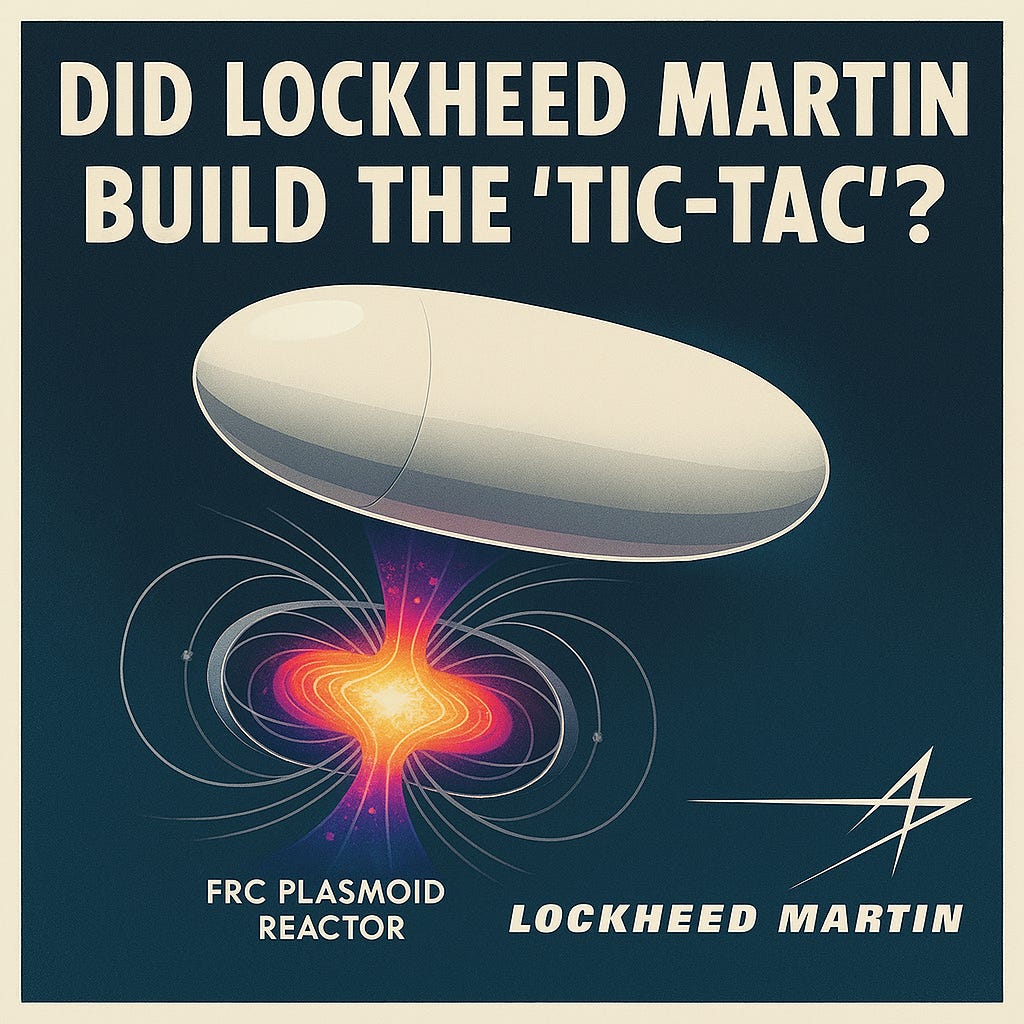
Lockheed’s Skunk Works already holds dozens of patents for field-reversed-configuration (FRC) plasmoids, high-temperature superconductors, and inertial-mass-reduction devices. In an FWT framework these pieces combine into a Frequency-Momentum (FM) cavity craft:
Plasma torus inside a toroidal reactor (mini aneutronic fusion or high-Q microwave discharge).
Phase-conjugate hull that converts incoming air & radar into longitudinal waves, making the craft optically dim and radar-shy.
FM gradient drive: by collapsing and re-inflating the plasma cavity asymmetrically, the ship “surfs” a moving node in spacetime rather than pushing air—hence no sonic boom and 30 g leaps.
All three behaviours were reported by the Nimitz pilots.
3. Why the military would stage a sea trial
Carrier strike groups are the Navy’s hardest radar test range.
A covert propulsion demonstrator can record its own signature vs. Aegis, SPY-1, FLIR, and fighter radar in one flight.
The orbs sometimes filmed near Tic-Tacs could be plasma guide-stars — drones that map the field so the main craft can jump without losing phase lock.
4. The biggest objection — energy source
Sceptics argue a ship-sized aneutronic reactor is still on the drawing board. But Tri Alpha’s and LPPFusion’s latest plasmoid tests show charged-particle fusion in suitcase volumes. Lockheed’s own FRC prototype (first revealed 2014) specifically targets direct-current power extraction — exactly what an FM cavity needs.
Bottom line
Coulthart may be wrong, but the physics isn’t. A Lockheed-built, plasma-cavity Tic-Tac is consistent with every observed flight characteristic and with patents the company already holds. In Frequency Wave Theory terms it is simply a craft that rides a self-created standing-wave node — and the U.S. defense giant most likely to attempt that trick is, indeed, Lockheed Martin.


